Inside the Smart ICU: Can Your Intensive Care Unit Think for Itself?
Intensive Care Units are the backbone of modern hospitals but they are also among the most overstretched. Rising patient volumes, staff fatigue, delayed interventions, and fragmented monitoring systems are forcing hospitals to rethink how critical care is delivered.
This is where the Smart ICU emerges not as a futuristic concept, but as a practical, life-saving evolution of the traditional ICU.
So the real question is no longer whether hospitals need Smart ICU technology but whether your ICU is intelligent enough to respond in real time.
What Is a Smart ICU?
A Smart ICU is a digitally connected intensive care environment powered by smart hospital monitoring software and advanced intensive care unit software. It integrates medical devices, patient vitals, clinical workflows, and analytics into a single, intelligent system.
Unlike conventional ICUs that rely heavily on manual observation, Smart ICU software continuously captures, analyzes, and alerts clinicians about patient conditions helping doctors intervene earlier and more accurately.
In essence, a Smart ICU doesn’t replace clinicians it augments clinical intelligence.
Why Traditional ICUs Are Reaching Their Limits
Despite skilled staff and advanced equipment, many hospitals still rely on siloed ICU systems that create critical gaps:
- Vital signs monitored on separate devices
- Delayed response to early warning signs
- Overdependence on manual charting
- Limited remote access for senior doctors
- High nurse-to-patient ratios leading to burnout
These challenges directly impact patient outcomes especially during peak admissions, emergencies, or staff shortages.
This is why hospitals worldwide are shifting toward smart hospital technology that enables centralized, real-time ICU monitoring.
How Smart ICU Software Works in Real Life
Modern intensive care unit software works by connecting bedside medical devices such as ventilators, cardiac monitors, infusion pumps, and oxygen sensors to a unified digital platform.
Here’s how a Smart ICU functions operationally:
- Real-time data capture from multiple ICU devices
- Centralized dashboards showing patient vitals at a glance
- Automated alerts for abnormal trends or deterioration
- Remote access for doctors via secure web or mobile apps
- Digital audit trails for clinical decisions and interventions
This closed-loop system transforms raw data into actionable clinical intelligence.
Can an ICU “Think”? The Role of Clinical Intelligence
While Smart ICUs don’t replace human judgment, they significantly enhance it. By continuously analyzing trends rather than isolated readings Smart ICU software helps clinicians answer critical questions faster:
- Is the patient deteriorating or stabilizing?
- Are vitals trending toward risk thresholds?
- Which patient needs immediate attention right now?
This predictive insight is what makes smart hospital monitoring software far superior to traditional ICU setups.
Smart ICU and Staff Burnout: An Overlooked Crisis
One of the biggest advantages of Smart ICU adoption is its impact on healthcare staff.
By automating routine monitoring and documentation, intensive care unit software reduces cognitive overload on nurses and doctors. Alerts replace constant manual checks, allowing staff to focus on care not screens.
Hospitals using smart hospital technology consistently report:
- Reduced alarm fatigue
- Faster clinical response times
- Improved staff efficiency
- Better coordination across care teams
In an era of global healthcare workforce shortages, this benefit alone makes Smart ICU adoption critical.
Smart ICU as Part of a Connected Smart Hospital
A Smart ICU doesn’t operate in isolation it is a core component of a digitally connected smart hospital ecosystem.
When integrated with:
- Remote Patient Monitoring systems
- Hospital Information Systems (HIS)
- Teleconsultation platforms
Smart ICU software enables continuity of care from critical admission to post-discharge monitoring.
This connected approach improves outcomes while reducing ICU readmissions and length of stay.
Why Indian Hospitals Are Rapidly Adopting Smart ICU Technology
In India, rising ICU demand, uneven specialist availability, and increasing regulatory scrutiny are accelerating adoption of smart hospital monitoring software.
Hospitals are now prioritizing:
- Centralized ICU visibility across branches
- Remote ICU access for senior consultants
- Data-backed clinical decisions
- Compliance-ready documentation
As a result, Smart ICU software in India is moving from “nice to have” to mission critical.
How Cognota Healthcare Is Redefining Smart ICU Care
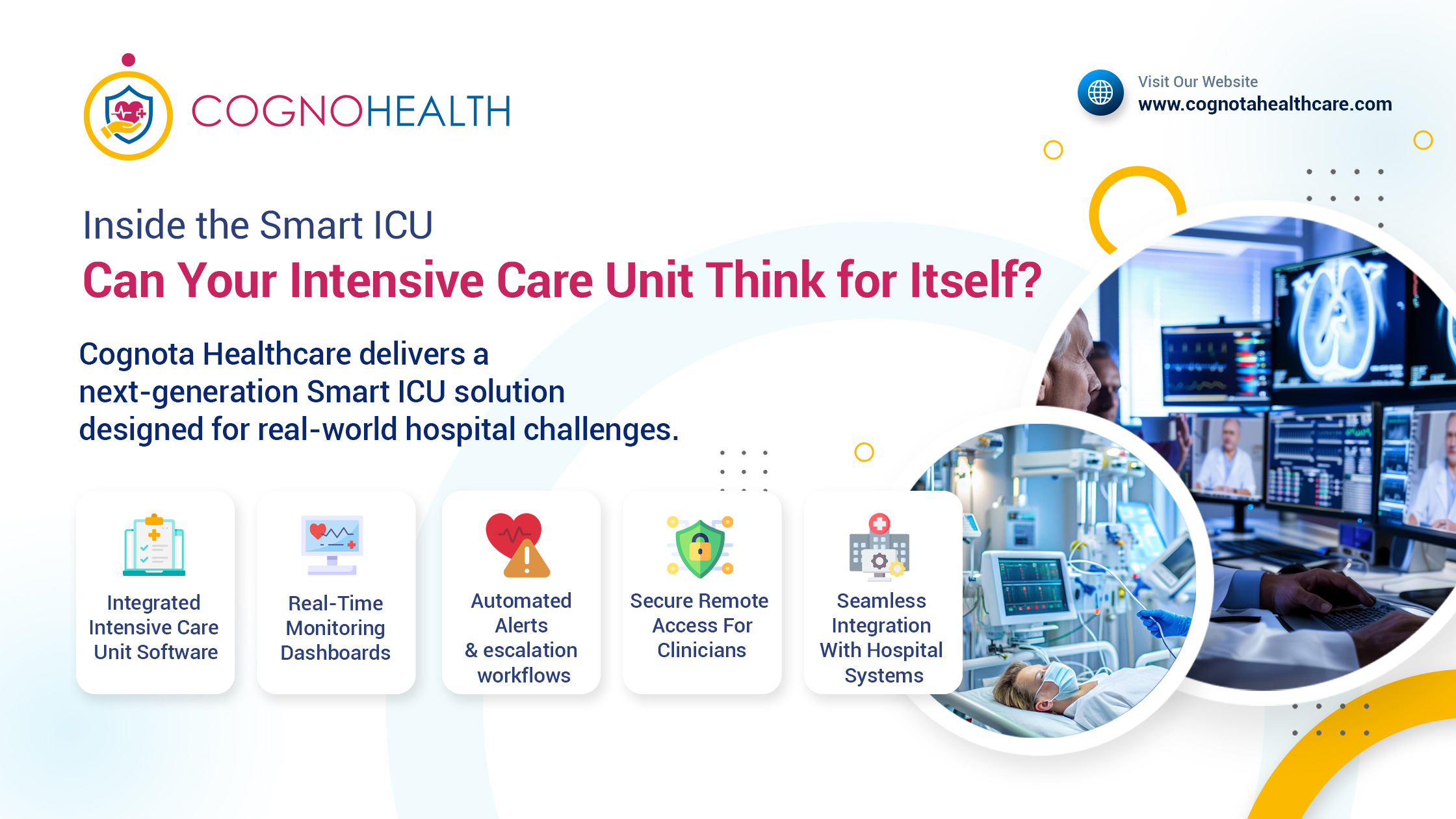
Cognota Healthcare delivers a next-generation Smart ICU solution designed for real-world hospital challenges.
Cognota Healthcare’s Smart ICU platform offers:
- Integrated intensive care unit software
- Real-time monitoring dashboards
- Automated alerts and escalation workflows
- Secure remote access for clinicians
- Seamless integration with hospital systems
Built as part of Cognota Healthcare’s broader smart hospital technology suite, the platform empowers hospitals to deliver proactive, data-driven critical care without increasing operational complexity.
Know more about [Smart ICU]
The Future of Intensive Care Is Intelligent
The future ICU will not be defined by more machines but by smarter systems.
As patient complexity grows and hospital resources tighten, Smart ICU adoption will separate reactive hospitals from resilient ones.
If your intensive care unit still relies on fragmented monitoring and manual processes, it’s time to ask the hard question:
If your intensive care unit still relies on fragmented monitoring and manual processes, it’s time to ask the hard question: